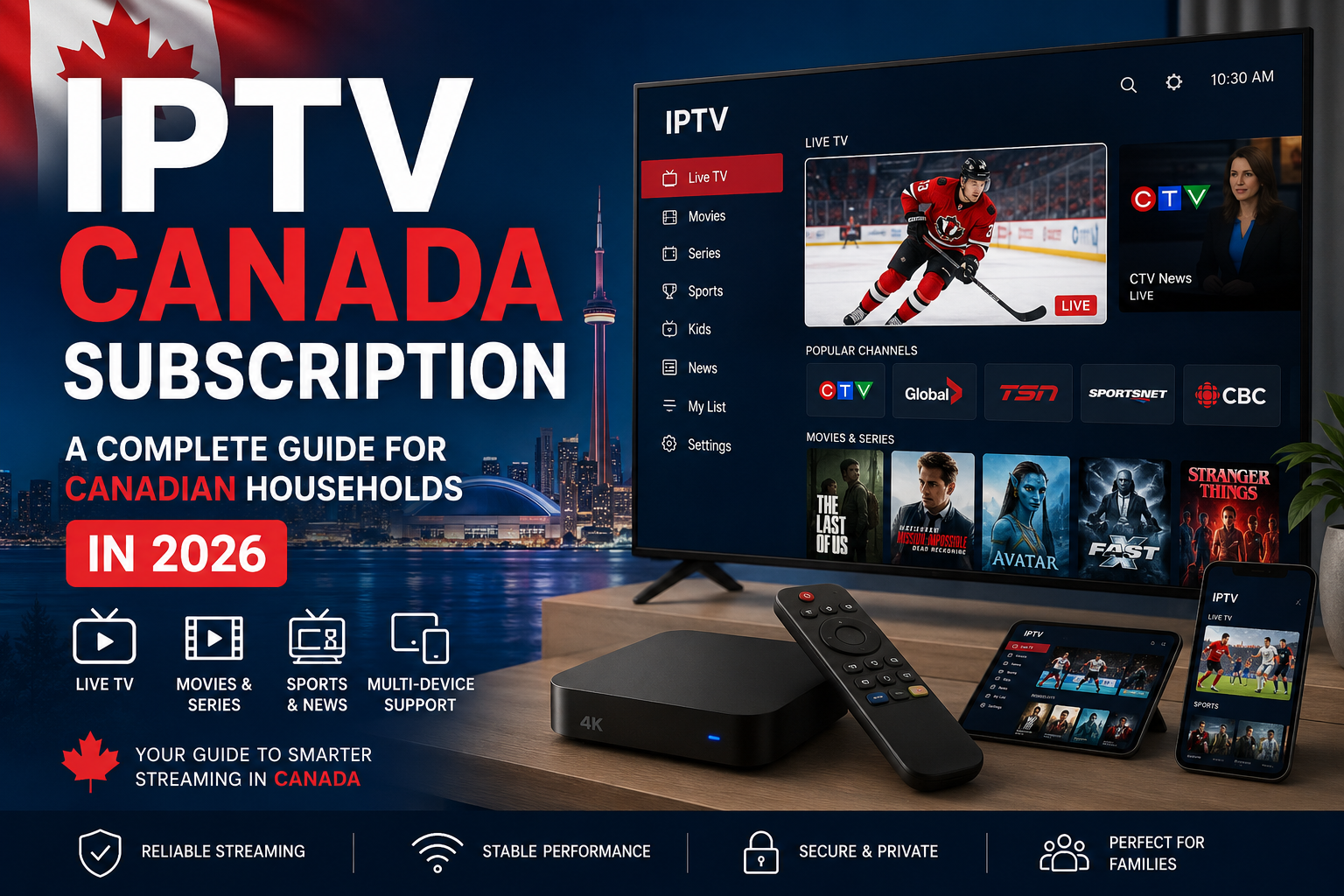
IPTV Canada Subscription: a complete guide for Canadian Households
Television habits across Canada have changed quickly. Many households no longer want to pay for a large cable package, rent several boxes, or remain tied to a fixed living-room setup. Instead, they want live television, sports, movies, series, children’s programming, and international channels available through the devices they already use.
That is why interest in an IPTV Canada subscription continues to grow in 2026. IPTV delivers television through an internet connection rather than a conventional cable or satellite signal. Depending on the service, viewers may be able to watch live channels, browse video-on-demand libraries, use an electronic program guide, replay recently aired programs, and stream on several types of devices.
However, not every subscription offers the same experience. Channel numbers alone do not reveal whether a service is stable, easy to use, compatible with your devices, or suitable for a busy Canadian household. Before subscribing, you should evaluate the provider, internet requirements, viewing habits, device support, customer assistance, terms, and content rights.
This complete guide explains how IPTV Canada subscription work, what Canadian households should compare, and how to build a reliable home streaming setup in 2026.
In 2026, households also expect a more polished experience than a simple playlist. Fast search, reliable guide data, profiles, subtitles, parental controls, responsive apps, and consistent picture quality now influence value. The best choice is therefore not the service with the biggest marketing claim, but the one that works predictably for your household every day.
What Is an IPTV Canada Subscription?
IPTV stands for Internet Protocol Television. In simple terms, it delivers television programming through the internet. A subscription normally gives the customer login details or access credentials that are entered into a compatible IPTV application, television, streaming stick, box, smartphone, tablet, or computer.
Traditional cable normally sends a fixed package through a provider’s network and often uses dedicated equipment. IPTV is software-based: subscribers open a compatible player, enter their credentials, and browse live channels or on-demand content.
A subscription may include Canadian and international channels, sports, news, movies, series, an electronic program guide, commonly known as an EPG, catch-up television, favourite lists, HD or 4K streams, and one or more connections.
Households comparing internet television with a conventional package should read this detailed guide to IPTV vs. cable TV in Canada. It explains the differences in pricing structure, equipment, content variety, flexibility, and dependence on internet quality.
Why Canadian Households Are Considering IPTV in 2026
The main attraction is flexibility. Different family members may want hockey, news, films, children’s content, or programming from another country. IPTV can place those choices in one interface and make them available on Smart TVs, streaming sticks, boxes, phones, tablets, and computers.
The cheapest plan is not automatically the best value. A useful subscription should combine relevant content, stable performance, responsive support, clear terms, and compatibility with the devices in your home.
For an overview of the qualities that separate dependable services from weaker options, see this guide to the best IPTV Canada services and selection criteria.
What Should an IPTV Canada Subscription Include?
Channel quality, organization, and relevance matter more than a headline number. Canadian households should compare the following features carefully.
1. Canadian and Local Content
Check whether the lineup contains the Canadian news, entertainment, French-language, English-language, regional, and sports channels your household actually watches. A provider may advertise extensive international content while offering limited Canadian coverage.
Ask for a channel list or trial where available. Quebec households may prioritize French-language content, while viewers in other provinces may require different regional networks.
Do not be distracted by an extremely large channel count. Search for the ten or twenty channels your household considers essential. A smaller but well-maintained lineup can be more useful than thousands of disorganized or unreliable streams.
2. Live Sports Reliability
Live sports are demanding, and popular events can place significant pressure on provider servers. Test the service close to normal game times because performance during a quiet weekday afternoon may not reflect what happens during a championship evening.
Hockey fans should check whether the relevant regional and national feeds are available. Other households may prioritize football, soccer, basketball, baseball, combat sports, motorsports, or pay-per-view events.
Ask whether sports channels are available in HD or 4K and whether the provider offers alternative feeds when one source becomes overloaded.
3. Video-on-Demand Library
A useful video-on-demand library should be searchable and organized, with accurate titles, language labels, subtitle information, release dates, and minimal duplication.
The total number of movies and series is less important than the quality of the catalogue. Check whether new content is added regularly and whether older entries remain playable.
Families may also want separate children’s categories, animation, documentaries, and family-friendly movies. Multilingual households should confirm the availability of dubbed content and subtitles.
4. Electronic Program Guide
An electronic program guide shows what is playing now and what is scheduled next. It makes IPTV feel more like a complete television service rather than a folder containing disconnected streams.
Check whether the guide loads correctly for the channels you use and whether the displayed times match your Canadian time zone. Incorrect program information can make live television frustrating, especially when recording, planning sports viewing, or searching for a specific program.
5. Catch-Up and Replay
Catch-up television lets viewers replay selected broadcasts after they have aired. Confirm which channels support it and how many previous days are available.
This feature can be useful for shift workers, parents, sports viewers, and households spread across different Canadian time zones. However, catch-up is not always available on every channel, even when the provider advertises the feature.
6. Customer Support
Before purchasing a long plan, send the support team a setup question and evaluate whether the reply is clear, relevant, and timely.
Reliable support should be able to help with activation, login errors, app configuration, connection limits, device changes, EPG problems, and basic troubleshooting. Generic or unrelated replies may indicate that assistance after purchase will be limited.
Choosing the Right Subscription Length
IPTV subscriptions are commonly offered for one month, three months, six months, or one year. A longer plan may reduce the average monthly cost, but it also increases the amount paid before you have tested long-term stability.
A one-month plan is a sensible starting point. It gives you time to evaluate channels, peak-hour performance, VOD, EPG accuracy, and customer support before committing to a longer subscription.
Before purchasing, verify:
- Whether the subscription renews automatically
- Which taxes or fees appear at checkout
- Whether the plan supports one or several simultaneous streams
- Whether changing devices requires assistance
- Whether a refund period exists
- Which conditions apply to refunds
- Whether account sharing is permitted
- Whether the advertised price is promotional or standard
Canadian consumer protections can differ according to the type of provider and service. The CRTC’s TV Service Provider Code covers many qualifying television providers and emphasizes clear agreements, promotional information, and notice of certain price changes. Always read the terms applying to the specific subscription you are purchasing.
Internet Speed Requirements for IPTV in Canada
A stable internet connection is essential for an IPTV Canada subscription. The speed printed on your internet bill is only the maximum speed associated with your plan. It does not guarantee that the television or IPTV device receives that speed through Wi-Fi.
As a practical household target:
- SD viewing may work with approximately 5–10 Mbps per stream
- HD generally requires approximately 10–25 Mbps per stream
- Full HD benefits from roughly 20–30 Mbps per stream
- 4K commonly needs 25–50 Mbps or more per stream
- Several simultaneous users require additional capacity
These figures are planning ranges rather than guarantees. Video compression, server quality, Wi-Fi strength, household activity, and device performance all influence the result.
For a deeper breakdown by video quality and household size, read what internet speed you need for IPTV in Canada.
Run a speed test beside the television during evening peak hours. Even a fast internet plan can produce freezing when an old router delivers a weak signal to the streaming device.
Ethernet is generally the most stable option. When a wired connection is not practical, use a strong 5 GHz or 6 GHz Wi-Fi connection and place the router where walls, floors, and household appliances will not weaken the signal significantly.
Best Devices for an IPTV Canada Subscription
The best device is one that supports your preferred application, handles your desired resolution, receives a stable network signal, and remains easy for the household to operate.
Smart TVs
Smart TVs may support IPTV applications directly, but older models can have limited storage, slower processors, or fewer application choices.
Using a built-in television application creates a clean setup because no additional device is required. However, an external streaming stick or box may perform better when the television’s operating system is slow or no longer receives regular updates.
Amazon Fire TV
Fire TV sticks are compact, affordable, and widely available. Newer 4K-capable models generally run more smoothly than older entry-level hardware.
Before choosing one, confirm that your preferred IPTV player is compatible with the device. Some applications may require installation methods that are different from downloading a normal app through the store.
Android TV and Google TV Devices
Android TV and Google TV devices offer broad app compatibility and flexible settings. Prefer certified hardware from a recognized manufacturer over an outdated generic box.
Certified devices are more likely to receive security updates, support modern video formats, and work correctly with official streaming applications.
Dedicated IPTV Boxes
Dedicated boxes can offer cable-like remote navigation, portal access, channel switching, and EPG use. They may appeal to viewers who want a traditional television experience without navigating a general entertainment interface.
Check whether the box uses M3U playlists, Xtream Codes, portal access, or another connection method supported by your provider.
Phones, Tablets, and Computers
Phones, tablets, and computers are useful for secondary viewing and travel, subject to mobile-data and provider rules.
Mobile viewing can also help you test whether a playback problem comes from the subscription or from the main television device. When the same channel works correctly on a phone but not on the television, the television app, Wi-Fi signal, or streaming hardware may be responsible.
Compare the major hardware categories in this guide to the best devices for IPTV in Canada.
How to Set Up IPTV at Home
The exact process depends on the device and application, but the basic steps are generally similar:
- Choose a suitable subscription and confirm device compatibility.
- Install a compatible IPTV player from the official application store where possible.
- Enter the login details supplied by the provider.
- Allow the application to load channels, VOD, and EPG information.
- Organize favourite channels and categories.
- Activate parental controls.
- Test live channels, movies, series, and sports.
- Connect through Ethernet or improve Wi-Fi if playback is unstable.
Keep your credentials private, type the server address carefully, update your software, and avoid unknown files from untrusted websites.
A missing character in a username, password, server address, or M3U link can prevent the subscription from loading. Copy and paste the details where possible, but check that no extra spaces have been added.
Device-specific instructions are available in the complete IPTV setup guide for Canada.
A Practical IPTV Canada Subscription Checklist
Before purchasing, ask the following questions:
- Are my essential Canadian and international channels available?
- Does the service provide stable sports streams during peak hours?
- Is the EPG accurate for my time zone?
- Which devices and IPTV players are supported?
- How many simultaneous connections are included?
- Is the internet connection in each room strong enough?
- Are the price, renewal terms, and refund conditions clear?
- Is customer support responsive?
- Are parental controls available?
- Does the provider explain its policies transparently?
- Are subtitles and language options clearly labelled?
- Can I change devices without purchasing another plan?
- Does the service work correctly during evening hours?
Test a trial or short plan properly. Use your essential channels, watch at different times of day, search the VOD library, and test every device you intend to use.
Do not spend the entire trial watching only one channel. A complete test should include live television, sports, movies, series, EPG loading, channel switching, subtitles, favourites, and support responsiveness.
Common IPTV Canada Subscription Mistakes
One common mistake is purchasing a yearly plan before testing the service. The discount may appear attractive, but the savings are meaningless when the service does not support your channels or devices.
Another mistake is selecting a provider based only on channel count. Thousands of channels do not guarantee working streams, useful organization, or accurate program information.
Some households also upgrade their internet unnecessarily. A buffering problem may be caused by weak Wi-Fi or an outdated Firestick rather than the internet plan itself.
Finally, users sometimes share their login details with too many people. This can exceed connection limits and make the account appear unstable. Protect your credentials and follow the provider’s usage conditions.
Frequently Asked Questions
What is the best IPTV subscription for Canadian households?
The best service should include your essential channels, support your devices, offer enough simultaneous connections, state clear terms, and perform reliably during peak viewing times.
The answer will differ between households because channel preferences, languages, devices, and internet conditions are not the same.
Is IPTV legal in Canada in 2026?
IPTV technology is legal. The legality of a particular service depends mainly on whether the provider has the appropriate rights to distribute its content.
Choose transparent services and avoid suspicious offers claiming to provide every premium channel or event at an unrealistic price.
How much internet speed do I need for IPTV?
One HD stream may work with approximately 10–25 Mbps. A 4K stream or a household using several devices will need more capacity.
Connection stability and Wi-Fi coverage are just as important as the advertised speed of the internet plan.
Can I use IPTV on multiple televisions?
Yes, when the subscription permits multiple simultaneous connections. Installing an IPTV application on several televisions does not automatically mean they can all stream simultaneously.
Check how many active connections are included before purchasing.
Do I need a special IPTV box?
Not always. Many Smart TVs, Fire TV devices, Android TV devices, phones, tablets, and computers support IPTV applications.
A separate box can improve performance when an older television has a slow operating system or limited app compatibility.
Why does IPTV freeze even with fast internet?
Possible causes include weak Wi-Fi, network congestion, provider-server load, outdated hardware, insufficient device memory, background downloads, exceeding the connection limit, or a faulty individual stream.
Testing another channel and another device can help identify whether the problem comes from the service or your home setup.
Should I buy a yearly IPTV subscription immediately?
A short plan allows you to test stability, customer support, content, EPG accuracy, and device compatibility before making a longer commitment.
A yearly subscription should normally be considered only after the service has performed consistently during peak viewing hours.
Is Ethernet better than Wi-Fi for IPTV?
Ethernet usually provides a more stable connection because it is less affected by distance, walls, interference, and nearby wireless networks.
Strong 5 GHz or 6 GHz Wi-Fi can also work well when the router is close to the streaming device.
Can I watch IPTV while travelling outside Canada?
This depends on the provider, application, location, and subscription rules. Some services allow international use, while others limit access or require assistance when the customer changes networks.
Confirm the provider’s travel and device-change policies before leaving Canada.